Every marathon plan builds to a point in both weekly distance and the distance for your long run. Both of these can vary depending on the person or the training plan you are following. And there is also a lot of advice out there on what you should do and should not do. Nothing I say here should be taken as gospel and should be understood that it applies to me and how I train. This might suit someone else but it also may not. A lot of the time I read and see people say that the longest run in a marathon training plan should be 20 miles (32/33km). This is long enough for your body to start to adapt to long distances but not too long that it will hurt you. After that point your recovery will suffer and you will find it either harder to get back out and run or find it difficult on future runs. This definitely makes sense and if its your first marathon and you are building up the distance from very little over the course of a training plan, this might apply to you.
However I go a bit farther. The advice I got from my father when I trained for my first marathon in 2018 was to get one 22 mile run in about 4/5 weeks out from the marathon. He had run multiple marathons and trained plenty of other people and always stuck by this. And after completing two marathons I have to agree with him, although I run 36km as I measure in kilometres instead of miles. There are a few aspects of it that I like. The big one is you are so close to touching that finish line of a marathon that it gives you great confidence for race day. If you can finished the 36km and think “I could run another 6km” you will probably be fine on race day. As opposed to another ~10km. Its also a good time to practice proper race nutrition that might not be as relevant if you aren’t running as far in training. In 2018 I was nervous on the morning of the long run more than the marathon as I figured as long as I could get through it then the marathon would be fine (which proved to be the case). I aimed to finish it under 3 hours which would line up with my desired time for the marathon.
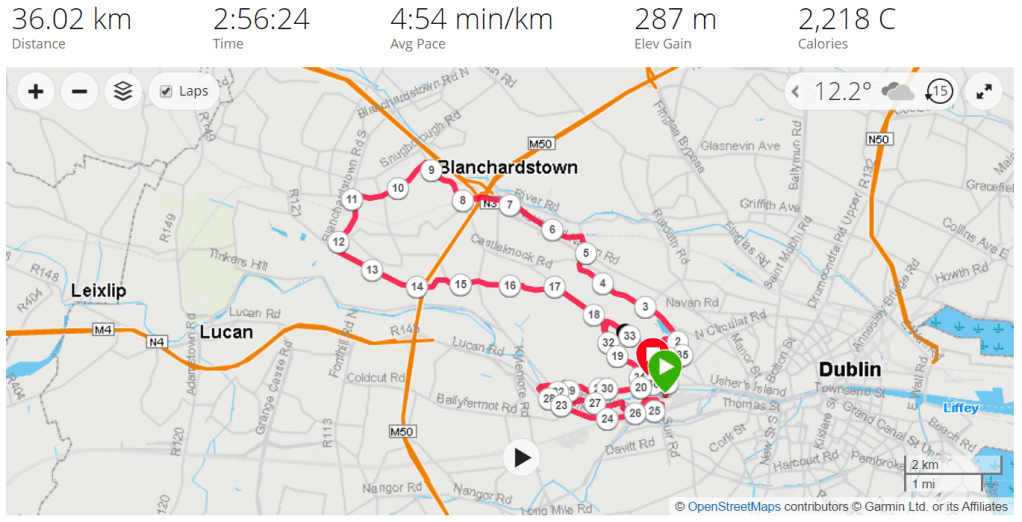
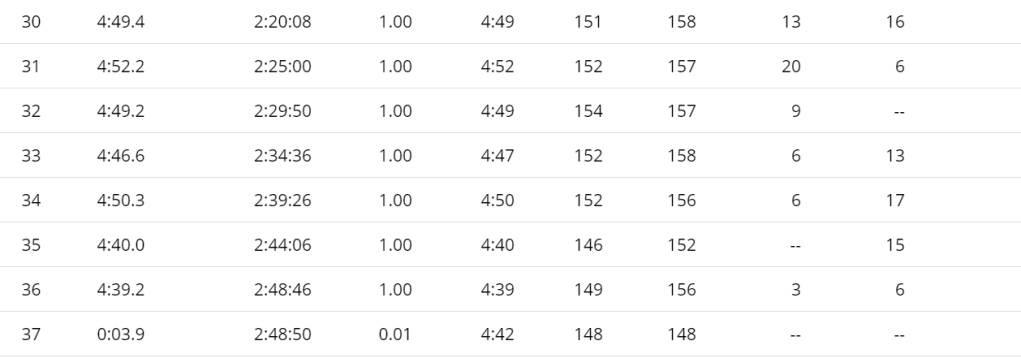
In 2019 I did the same thing although the run did not go as well. It was the morning of the Ireland v Japan rugby world cup game and that threw my routine off a bit. Also the Irish loss probably left me in a bad mood as I started to run which didn’t help. Although there is nothing like a 36km run to forget about a bad rugby game. The first three quarters of the run were pretty good but my energy started to wane towards the end and I just couldn’t keep up the pace. I put this down to the routine change although I should have taken it to mean I didn’t have the stamina to maintain my desired pace. This showed itself in the marathon as I struggled home in the final 6.
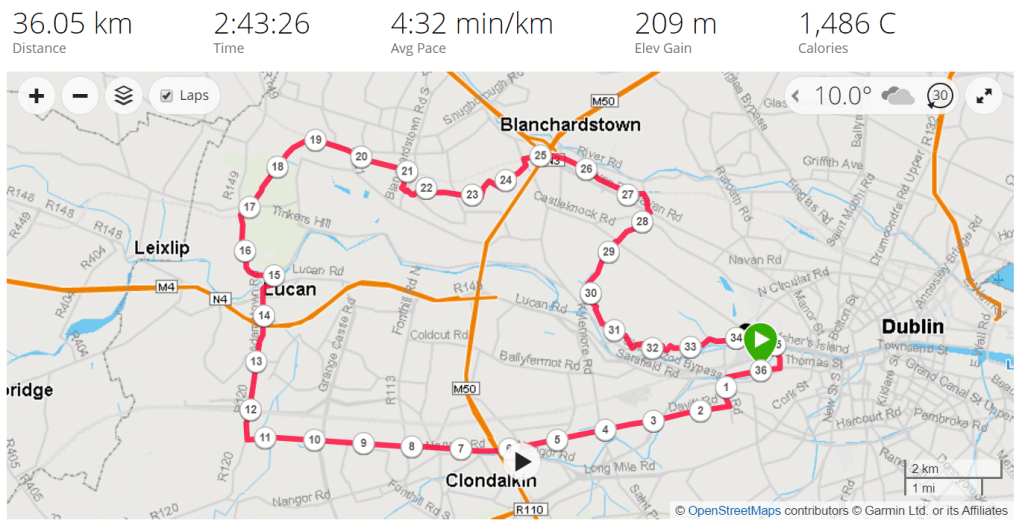
This year I was not going to let that happen. I wanted to make a statement with the run and prove to myself I had improved from last year. I settled into a shockingly consistent pace from the start holding between 4:32 and 4:38 for most kilometres. It was a lovely day for running and I had picked a pretty interesting route that took me a long way from home and ran along both the Grand Canal and Royal Canal. As I entered Phoenix Park around 28km I realised there was a 5 mile race going on. I ended up joining the back of it and ran through it from 29 to 33.5km which gave my pace a nice boost. I then slowed it back down and ran two cool down kilometres home. Finishing it left me filled with confidence after feeling so strong out there and matching my pace from the Dublin Marathon last year. Running that distance in training is definitely not for everyone but if you feel you can recover from it then I highly recommend it ahead of a marathon.
 259 Running
[…] last few months. I ran a new 10 mile PB in Dungarvan and I matched last years marathon pace in my 36km long run. I have learned more about different training types such as internvals and recovery. My nutrition […]
LikeLike