I previously discussed the journey I took in creating a running plan for myself in Planning My Runs: Learning from my mistakes. Its been a bumpy ride but I have certainly enjoyed it and grown as a runner. Personally I like to create my own plan (with some guidance) for two main reasons. I have a better understanding of what training gets added to the plan. I need to understand why I run a certain distance on a given day or a certain pace the next day, if I am going to put these things into a plan. It also gives me more freedom to adjust the plan. You often see people worrying about having to move their long run to Sunday because they are busy on Saturday, or missing a midweek run because its what their plan dictated. If I find myself busy on a day I know how to adjust the schedule so I maintain the same level of training. As previously mentioned, this is not for everyone and some people will work much better from a plan created for them by someone else. The other important aspect for why I like to create my own plan is I love spreadsheets. I’m a big nerd who enjoys looking at fields of data and manipulating this to try and find every minute detail. Creating my plan has been a great excuse to dive into the data and see what I can do with it.
Before diving into the plan I will outline the seven types of runs that make up the plan:
- Long Runs: This is the main run of the week, usually on a Saturday morning. Minimum of 21km but generally farther. Pace can vary depending on the day. Often I will run 2/3 warm up kilometres, find a steady pace for the majority of the run and then try finish strong running at a fast pace for ~5km towards the end, before finishing with a couple of warm down kilometres.
- Recovery: Very slow run, generally the day after my long run. Read recovery runs for more details.
- Slow Runs: Medium length runs at a slow pace (over 4:50 per km) and usually between 8-12 km
- Tempo Runs: Faster pace run (4:20/4:30 per km) usually not as long as the slow runs, around 8-10km
- Intervals: Short high intensity running with a rest period in between each.
- Hill Runs: Either an interval run performed on a hill for hill repeats or a slower run that involves a lot of hills.
- Races: Exactly what it says on the tin. Important to work races into the schedule so you can plan around them
For the start of 2020 my primary focus is training for the Manchester Marathon in April. With only 14 weeks from the start of the year to the start line, training needed to begin immediately. I wanted to build on the lessons and the training of last year. This meant swapping from a week-to-week schedule to planning out each day of the week. I also set out weekly targets for my kilometres which I had not done in previous years. To continue improving at long distance running I feel that I need to run more kilometres per week than previous years so it was important to set out these targets early. I planned out my long runs for each weekend up to the marathon. These runs tend to be the focus of each week and it helped to set the weekly targets around them. Beginning in January I wanted to start with a solid base of running up to the Dungarvan 10. Then in February start increasing my kilometres each week from 70 to 80 and then 90. I hold that maximum for three weeks into March and then taper back down to the marathon. I also moved up from running 3/4 times a week in 2019 to 5/6 times a week which was a significant jump.
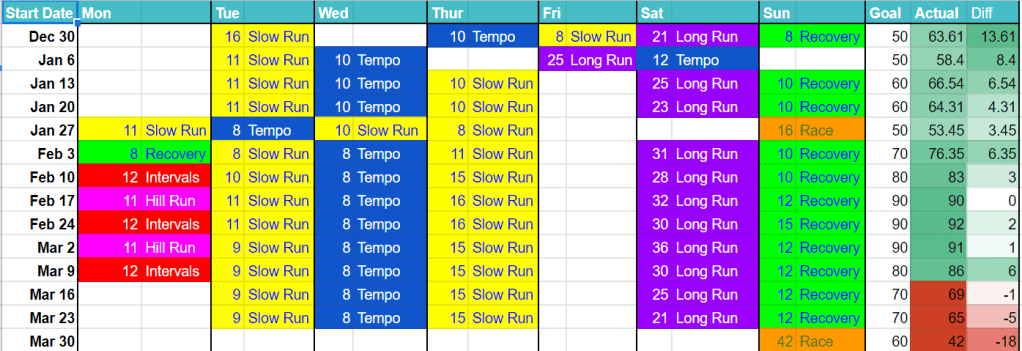
Once the weekly goals and the long runs were mapped out I started to fill in the rest of the runs. I knew Sundays would usually be my recovery run but the middle of the week had more variety. None of these were necessarily set in stone and I tend to review the distances and the days closer to the time. Initially I just ran slow runs and tempos while building the base in January. Now in February I plan to introduce hill runs and intervals, in one session per week, to work on speed, power and recovery. I felt that introducing these too early, especially as I was running more than the last three years, might lead to injury or burnout. You can see in the image above that I have not mapped out the taper weeks yet for the shorter runs and this is highlighted in the weekly goal on the right. I will work to put a schedule together in order to meet the weekly goal based on the various run types.
One of the key things for me was to maintain variety in my schedule and to avoid multiple high intensity runs beside each other which may lead to injury or burnout. In another sheet I log the basic details for each run that can be sorted, filtered or queried later such as date, distance, pace etc… One of the things I track for each run is an Intensity rating on a scale of 1-7. This is a subjective measure of the run based on how hard (fast pace, elevation gain, distance) the run is and taking into account how I felt while doing it. This rating is used to identify when I might be overworking myself or how certain runs in the schedule affect others. I can then adjust the schedule appropriately to keep performing at my best.
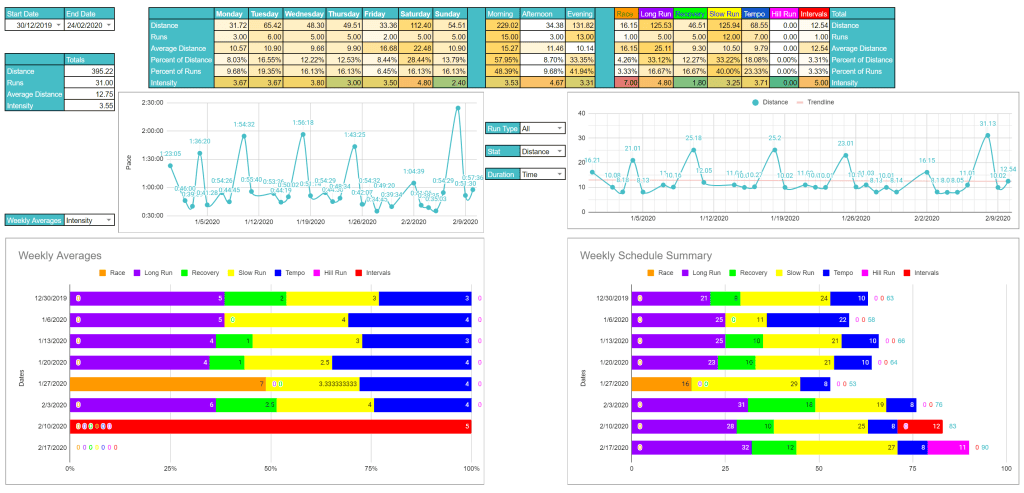
One of the final things I added (and continue to work on) is a summary page that can gather some of the data together for easy viewing. On the top left in the image above there are two drop down boxes to select the start and end dates for the summary. This way you can view the data only relevant to a specific period of time (e.g. a 14 week training cycle) and the tables and charts dynamically update given the range of dates. A lot of this is to satisfy my love of spreadsheets but there is also useful data to identify and gaps in the schedule or if I am overworking in a certain area. I can recognize gaps in my training such as a lack of runs over an hour. After seeing this I adjusted my schedule in order to accomodate a longer run during the week. I’ll continue to tweak and work on this dashboard as time goes on to hopefully deliver better and more useful data.
It has been interesting working from a more concrete plan this year in the build up to the Manchester Marathon. While I still adjust as I go along, having everything mapped out has made me feel much more confident in my training. This has especially been useful as I build up to more kilometres each week and I want to avoid hurting myself. I took the lessons I learned from the last few years and built upon them to form a much more stable plan this year. And the spreadsheets have been a fun side project keeping me engaged in my running. It has also delivered great results already with a new PB in the Dungarvan 10.
 259 Running