There is a saying, which I believe originates from the British Army, that I learned from the book Boy Soldier by Andy McNabb which is the 6 P’s. “Prior Planning Prevents Piss Poor Performance”! There are a few variations on this, however the sentiment is the same. It has stuck with me for the last 15 years, partially because I thought it was funny when I was younger, but I strongly agree with it now when it comes to running. If you want to perform on race day you need to have some plan for training and some plan for the day of the race. I have learned this the hard way. My plans for running have been largely self guided which has both its advantages and disadvantages. I think I have gained a greater understanding of the things I do in training but its meant making many mistakes along the way and possibly slowing down my progress. This is by no means meant to tell everyone to follow my example. A lot of people work great from a hard plan written by someone with more expertise. There are certainly plenty of great running plans out there. I think the important thing is to find what works best for you and to understand it. However with this post I wanted to explore my journey in planning how I run and how that has developed over the years.
Part of my philosophy is akin to how I cook food. I rarely follow a full recipe from start to finish. Everyone out there will claim that their way is the one true way to cook a dish. But they can’t all be correct. When I think of something I want to cook, possibly inspired by an initial recipe, I will go to Google and read 5/6 different recipes. From those I can identify the common ingredients and elements which would count as essential. The remaining elements I can choose from with what suits me best, whether that be flavours I enjoy or maybe availability in a nearby shop. The first time I make the dish, it probably is not at its best. It presents the opportunity to learn and improve though as I make the dish more times. I’m left with a better understanding of the food I cook and gives me more freedom in the future rather than sticking to some hard and fast rules. My training plans have followed a similar pattern of finding out what others are doing and trying to find what works best for me.
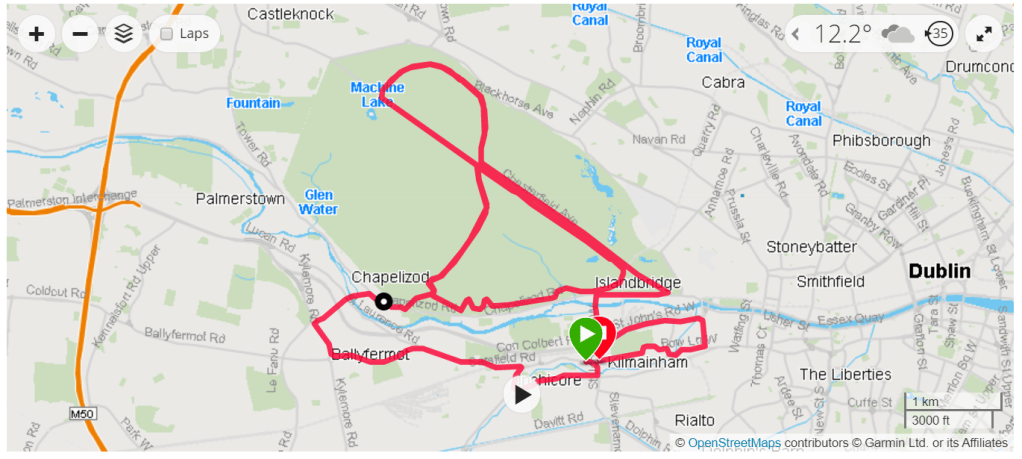
It has not been a smooth road to my current plans. Back in 2017 I was training for a 15 mile race at the start of October, Cork to Cobh. My plan consisted of running the same 25km route every Saturday morning. I was struggling with this and all I was doing was training to run this one specific route. This culminated in walking at mile 13 of the race and finishing with a time that I was not pleased with. The following year I planned to run the Dublin Marathon in October and knew I needed to learn from my mistakes of the year prior and improve my training plans. Over the summer I ran, what I refer to as rotations, for my long runs at the weekend: 21km at a fast training pace, 25/26km at a regular pace the next week, 30km at a slow pace on the final week. Do that for the three weeks and repeat. This gave me some long distance experience well ahead of the marathon but still gave me a chance to push myself on the shorter runs. As the marathon neared I made a long run schedule for my long runs (2 x 32km, 1 x 36km) so they would fit around a couple of races and appropriate shorter runs. This was a massive improvement over the previous year and the numbers agreed. I improved my PB’s by 4 minute for 10 mile , 9 minutes for half marathon, 20 minutes for the same 15 mile race and ran 3:22 for the marathon in the space of two months.
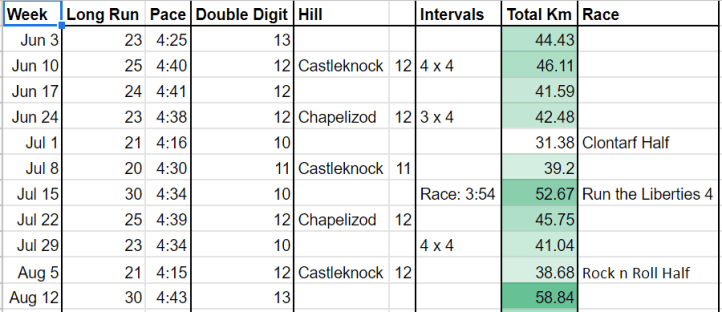
In 2019 I was once again planning to run the Dublin Marathon. At the beginning of the year my training felt a little aimless. Even though I was getting good runs in, it lacked focus or direction. Around June I fixed this with a few rules and plans. There were three rules put in place:
- One double digit distance (>= 10km) as a midweek run
- Interval training once every two weeks
- Run one of the two difficult hills near me once every two weeks
I also mapped out my long runs in the months leading up to the marathon so I knew what I was doing each weekend. This was all tracked week to week in a spreadsheet so I could keep an eye on these goals and track my progress in the months leading up to the race. The sheet also tracked the kilometres I ran per week but I had not set any strict goals in that regard.
Each year has seen significant improvement in my training which has resulted in better performances at races. While I do not necessarily recommend my approach to forming a plan (and failing initially), I would suggest you understand the plan you run with. I will explore my current training plan in more detail in a future post.
Key Takeaways When Forming A Training Plan
- Mix up your routes and distances: Different routes and distances will improve your training and keep things interesting when you head out for your runs
- Find out what works best for you: No plan will work for everyone so its important to understand what training suits you best. When you understand yourself and your plan, your training will improve.
- Plan your long runs well in advance: This mostly applies to longer distance races but can be used for any training. Planning ahead avoids over training and burn out, allows time to taper and keeps your focus. It also allows you to fit any races around your training plan.
- Set some goals for your training: Whether it be a certain number of runs, weekly distance or doing certain types of training. Small goals can add a focus and direction to your training on top of any race that might be waiting at the end.
 259 Running
[…] previously discussed the journey I took in creating a running plan for myself in Planning My Runs: Learning from my mistakes. Its been a bumpy ride but I have certainly enjoyed it and grown as a runner. Personally I like to […]
LikeLike